

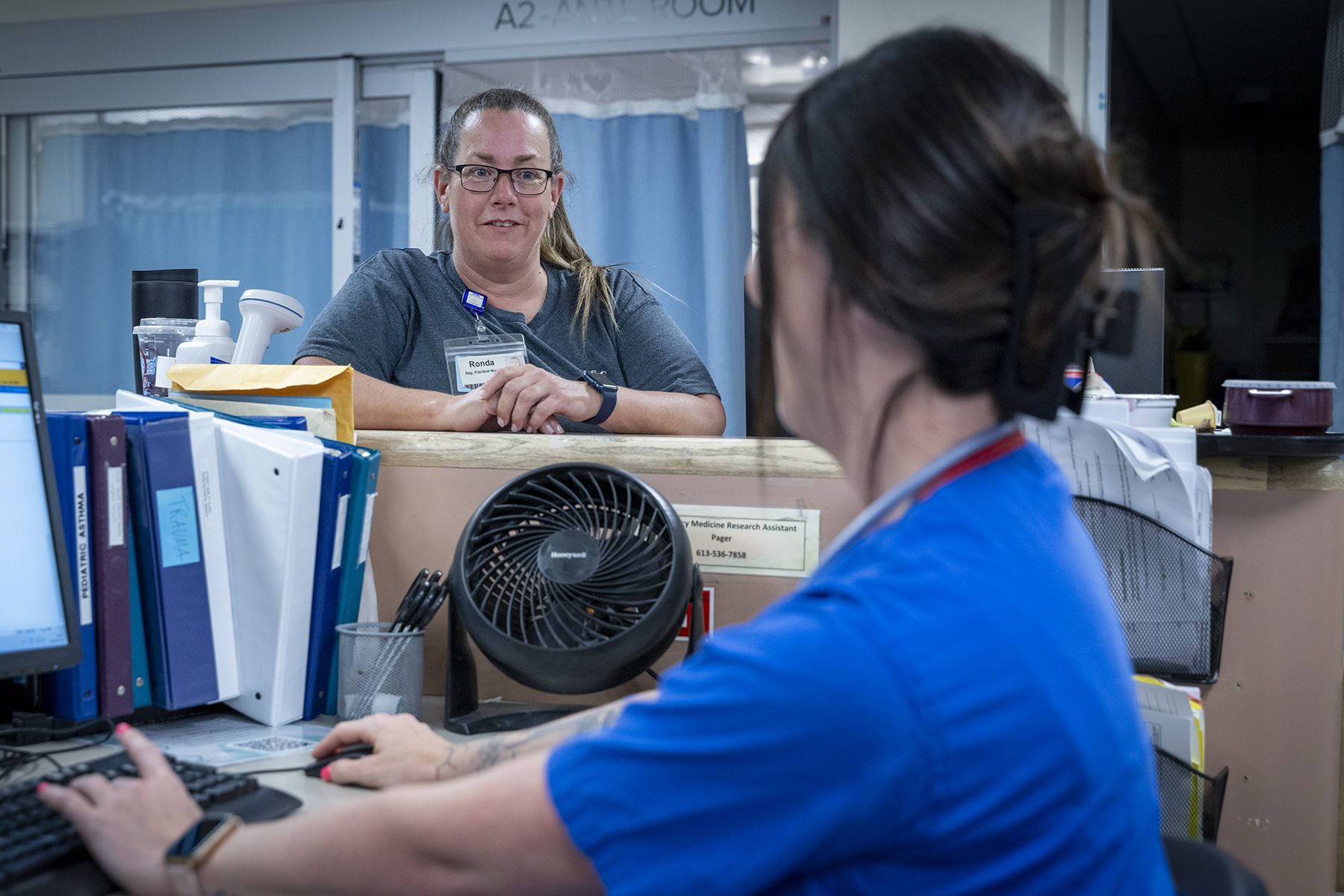
Waiting room nurse Ronda Gallant at the ED care desk where she and others in the role work with charge nurses to support the flow of patients into the department.
Credit
Matthew Manor
Waiting in Kingston Health Sciences Centre’s Emergency Department (ED) has looked and felt different this year, with a nurse working 24/7 in the waiting room to monitor and reassess patients who have already been triaged, improve communication between patients, families and staff, and start care early when it is needed.
Since the role began in March, the department has seen a drop in the number of patients who leave before receiving treatment. By checking in regularly, explaining delays, supporting the flow of patients into the ED, and starting care, such as drawing bloodwork, performing ECGs and starting IV lines, the waiting room nurse makes the wait more comfortable and lowers the risk of missed or delayed diagnoses.
For patients, the change is easy to feel.
“Having this nurse in the waiting room, coordinating which patient was to go into the ED, checking vitals along with making sure that everyone was taken care of was very comforting,” wrote Dianne McNamee in an email to Patient Relations.
“Waiting can be one of the hardest parts of an emergency visit,” says Jaime Gardiner, KHSC’s ED program manager. Since adding a waiting room nurse, we’ve seen positive compliments double. It’s a clear sign that when patients feel seen early, their whole experience of care can improve.”
KHSC’s ED is a busy place. It serves local communities, is the trauma centre for southeastern Ontario and is the access point to regional specialists. On any given day, the waiting room seats people of different ages and an incredible range of conditions, from a child with a persistent fever to a worker with a cut hand to someone anxious about their cold symptoms.
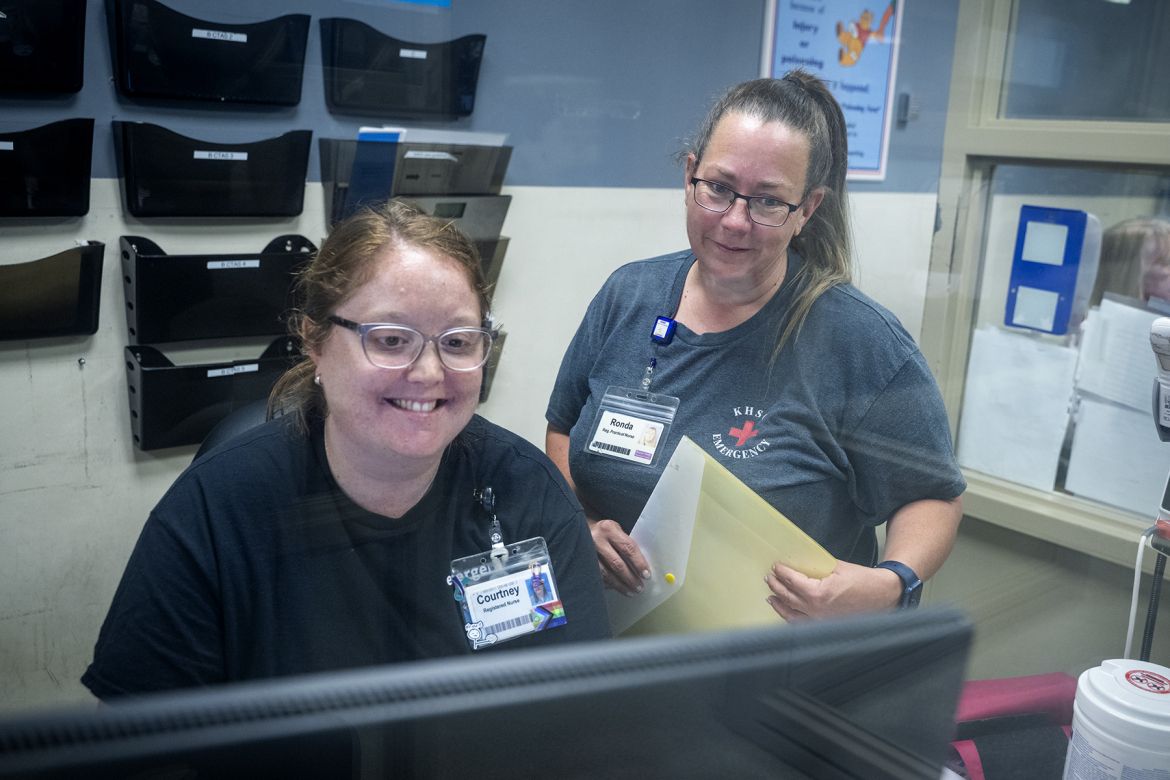
Upon arrival, triage nurses assess patients and decide in the moment the order in which a person should be seen based on the seriousness of their injuries or conditions and how urgent they need medical care. The waiting room nurse makes sure the order is still right over time.
After triage, hidden among the crowd may be a high-risk patient whose condition is getting worse. It’s the waiting room nurse’s challenge to recognize the subtle warning signs: a changing colour, a shift in breathing, a person who has gone unusually quiet.
Experts have said it’s a bit like a Where’s Waldo exercise. Except in the ED, Waldo doesn’t wear a red-and-white striped shirt, and someone in the crowd can become Waldo at any moment.
When a patient’s condition changes, the nurse tells the medical team so worsening cases can be seen sooner. From the waiting room, this prioritization may not be understood, but it is how lives are saved.
Even when patients like McNamee know the wait is going to be long because they can see the department is very busy and the seriousness of patients’ conditions, waiting can be stressful and frustrating.
To help ease that frustration, the waiting room nurse may explain why waits happen. The ED is not a standalone unit, but part of a much larger network of people and services throughout the hospital and sometimes beyond. That includes on-call specialists in surgery, obstetrics, general medicine and cardiac care, as well as testing services such as laboratories and diagnostic imaging.
Those moving parts give patients access to expertise and technology, but each one is also another place where care can back up. With so many connections where things can slow down, the new role lets care begin earlier, right there in the waiting room when it is needed.
Around the time the position was introduced, the number of medical directives available to all ED nurses doubled, allowing them to perform more treatments and procedures or give certain medication without waiting for a doctor’s or nurse practitioner’s (NP) direct order.
This means patients are getting care started while they wait, so by the time they see a doctor or NP, key information and early results may already be available.
Monitoring, reassessing and starting care early in the waiting room helps patients move through the department more smoothly and improves their experiences.
“I felt that all my needs were taken care of,” says McNamee. “It was a very positive experience.”
While the waiting room nurse does not shorten every wait, since the pressures on the wider system remain, the role does make sure no one is forgotten or uninformed.


